

Hypnovember 2026 – Day 9
We’re entering this challenge for the first time, using the list below as a reference to write a series of flash fiction pieces. Come along on this journey, and let’s continue to have fun.
You can thank https://x.com/Skronos_ for creating such a detailed selection of deliciously kinky concepts to work with.
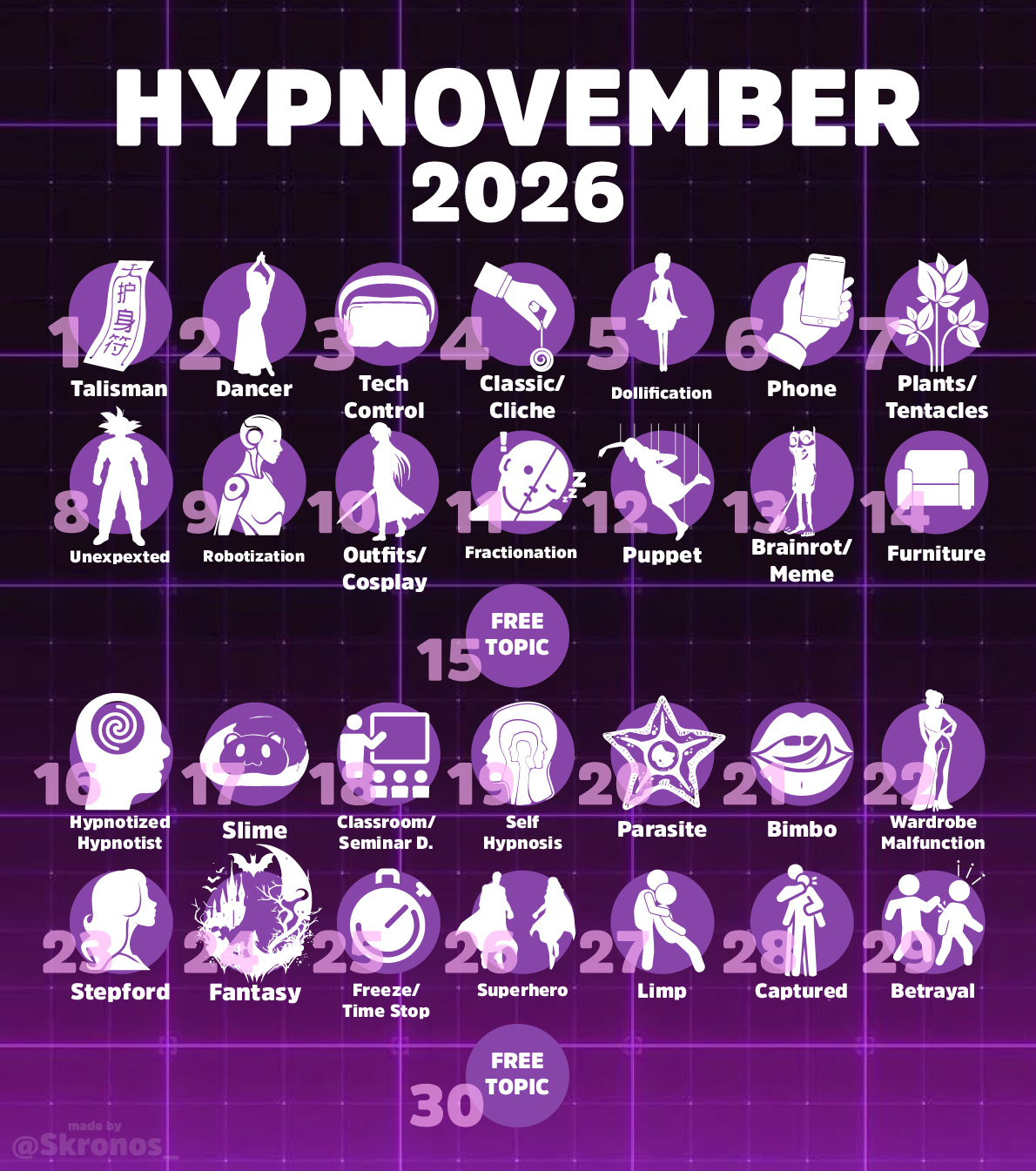
Day 9 – Model Employee (Robotization)
The android stood on a rotating platform at the center of the Kuroda Dynamics booth, and Aiko Tanabe recognized her own hands.
Not literally. The android’s hands were silicone over a carbon frame, slender and pale. But the way the fingers curled when it gestured, and the slight hesitation before it bowed: Aiko had written that code over three years, alone at night in a basement lab in Suita, while Shun Kuroda handled what he called the business side.
Then Shun had handled the business side all the way out the door, along with her motion-capture rig and the patent application she had been too trusting to file in her own name.
“Welcome to the future of hospitality,” the android said to the crowd at Intex Osaka, in a voice Aiko had recorded herself. Shun stood beside it in a tailored suit, accepting applause.
She did not sue. Her lawyer said it would take six years and that Shun’s investors had better lawyers. So she went back to her basement and thought about what she still had. She did not have the code anymore, but she had something better: the understanding of how it all worked.
The motion-capture rig was the heart of the android. An operator wore a lightweight harness and a visor, and moved. The rig recorded every gesture and translated it into instructions the android could follow. What Shun had never grasped, because he had never read past the first page of her documentation, was that the translation could run in both directions. The rig could teach a machine to move like a person. With a few adjustments, and the right visual pattern in the visor, it could also teach a person to move like a machine.
Aiko spent the winter on those changes.
In March, she sent Shun an email. It was polite and slightly desperate, which she knew he would enjoy. She wrote of calibration improvements too valuable to waste, and offered to sell if he came in person. He arrived at her basement the next evening with two bodyguards, whom she asked to wait upstairs. He let them. He had never once considered her dangerous.
“You look tired, Aiko,” he said, settling into the harness without being asked. He always had to try everything first.
“I am,” she replied, and lowered the visor over his eyes.
The pattern was simple: a grid of soft white lines, pulsing at a frequency she had spent months tuning. Under it ran a low tone, almost below hearing, and her own voice, recorded in the same calm register as the android’s.
“Calibration beginning,” said the voice. “Please hold still.”
Shun held still.
“Movement is inefficient,” the voice continued. “Hesitation is inefficient. A model employee completes each task in the correct sequence. A model employee waits for instruction.”
She watched his shoulders square. His breathing slowed until it matched the tone. When she instructed him to raise his right arm, it lifted in a smooth arc and halted at precisely ninety degrees. When she told him to lower it, it descended at identical speed and rested against his side without a sound.
It took nine sessions. Shun came back for each of them on his own, because she told him to and because, after the second, he no longer remembered that he was free not to. By the end, he could stand on a rotating platform for six hours and bow at a precise thirty degrees. He could greet a visitor in seven languages in a bright, flat voice that did not belong to him, and he could not stop smiling until someone said the release phrase.
Aiko taught that phrase to only one person: herself.
At the autumn trade show, Kuroda Dynamics unveiled its second-generation model. The crowd at the booth was twice the size of the year before. The new android wore a silver suit and a silver visor, and it moved more naturally than anything the industry had seen. It answered questions and recited the company’s quarterly results. When a journalist asked who had designed it, the android turned its head with a soft whir that came from a speaker in its collar and said, “The original design belongs to Dr. Aiko Tanabe.”
The booth went quiet. Then the android said it again, with the same bright, flat smile, and added the patent number.
Shun’s investors had better lawyers than Aiko did. They also had shareholders, and the shareholders had watched the video, which reached four million views by the next morning. The company settled within the month. The patents went back to Aiko, along with a controlling share of Kuroda Dynamics and a new name on the door.
She kept the second-generation model. It stands now in the lobby of Tanabe Robotics, on its rotating platform, greeting visitors in seven languages. It never tires. Most people think it is the most lifelike android ever built.
On Fridays, after the staff goes home, Aiko says the release phrase, and Shun lifts his visor and blinks at the empty lobby as if he can’t quite remember how he got there. She lets him stand there for a minute, looking at the name on the wall. Then she says the activation phrase, and he bows at thirty degrees.
“Good evening,” he says brightly. “How may I assist you?”
