

Hypnovember 2026 – Day 23
We’re entering this challenge for the first time, using the list below as a reference to write a series of flash fiction pieces. Come along on this journey, and let’s continue to have fun.
You can thank https://x.com/Skronos_ for creating such a detailed selection of deliciously kinky concepts to work with.
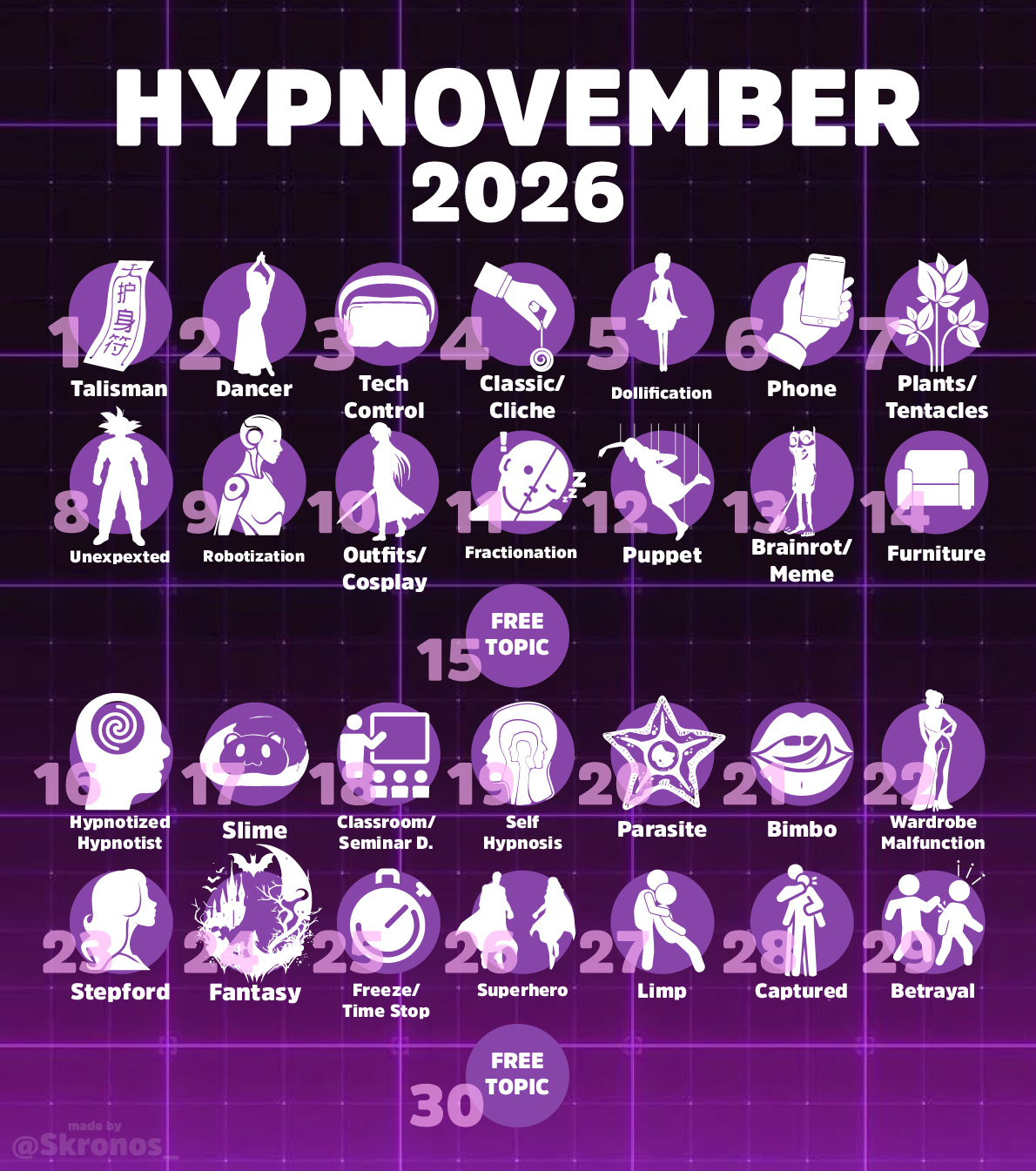
Day 23 – Property Values (Stepford)
The listing said, Fairwinds Estates: a community that takes care of its own.
Joanna Reyes-Bright had been reading real estate listings professionally for nine years, and she knew that line meant an HOA with opinions about mailbox color. She rented the house on Larkspur Lane anyway, because the rumors about Fairwinds were the best story she’d had in two years.
The rumors came from a message board. Women who had moved out of Fairwinds, after divorces or job transfers, wrote about husbands who changed. Not gradually. Within a season. Men who had been difficult became helpful. Men who had shouted stopped shouting. One woman wrote that her husband had gone into Fairwinds a bully and come out of it the man she had hoped she was marrying, and that she had never been able to decide how she felt about it.
Joanna moved in on a Tuesday in September with a rented sedan, a fake husband named Marcus who was actually a photographer she’d worked with for years, and a plan to be out by Christmas with eight thousand words.
Deborah Kinney came by on Wednesday with a coffee cake.
She was sixty, in a linen blazer, with a realtor’s handshake and the direct, friendly eyes of a woman who had sold four hundred houses. She had also, Joanna’s research showed, lived in Fairwinds for thirty-one years, served nineteen on the board, and personally brokered sixty percent of the sales inside the gates.
“Welcome committee meets the first Saturday,” Deborah said. “Ten o’clock, my house. Both of you come.”
The welcome committee was nine women and a lot of pastry. They sat in Deborah’s sunroom and talked about the leaf collection schedule, and then, around eleven, Deborah asked the new husbands to come through for the orientation.
Marcus went. Joanna, who was supposed to be a wife, stayed in the sunroom and ate a danish and listened very hard through the wall.
She heard Deborah’s voice, low and even, for about twenty-five minutes. She could not make out words. When Marcus came out, he looked rested and a little dazed, and on the drive home he told her, unprompted, that he had been a bad partner to his ex-wife and that he’d been thinking about calling her to say so properly.
Joanna had her story. She spent the next six weeks getting the rest of it.
What she found was not what the message board had implied. There was no drugging, no chemicals in the water, no cult. There was a woman who had trained as a hypnotherapist in the 1980s, had done it badly and quit, and then had come back to it twenty years later with a specific and narrow idea.
Deborah did not make men into anything. She did one session, twenty-five minutes, in a sunroom, with four other women present as witnesses and a recorder running. The session did one thing: it took whatever the man already believed about how he ought to treat his family, the version of himself he described when asked directly, and it set that belief where he could reach it. It removed nothing. It added nothing.
Men who had nothing good in there came out unchanged. Three had, over the years. Deborah kept the recordings and advised their wives privately, and two of those marriages had ended.
Joanna found that out in November, when she finally stopped pretending and told Deborah who she was.
They sat in the sunroom for four hours. Deborah did not deny anything. She brought out the files: thirty-one years of consent forms, signed by every man before every session, witnessed, with a clause about the recording and a clause about the right to refuse. Most men signed. Some didn’t, and nothing happened to them.
“You could have made them perfect,” Joanna said. “Any of them. All of them.”
“I could have made them mine,” Deborah said. “That’s a different thing, and it’s the thing I did once, in 1987, to a man I was married to. It worked, and I hated every day of the eleven years that followed. He was so pleasant. There was nobody in there.” She closed the folder. “So now I only hand men back what they already said they wanted to be. If there’s nothing there, I can’t invent it.”
Joanna published in March, thirteen thousand words, with the consent forms reproduced in full and Deborah’s name on every page, with her blessing. It did not read like an exposé. It read like a question nobody had a clean answer to, including Deborah, including Joanna, and the comment sections argued about it for a year.
The state ethics board reviewed the practice and could not decide what to call it. A bill was drafted in Hartford, then quietly shelved.
Joanna still lives on Larkspur Lane. Marcus did call his ex-wife, and they’re friendly now, and he says the Saturday in the sunroom was the best thing that ever happened to him.
Joanna sits on the welcome committee these days. She brings the danishes, and she takes the notes, and once a month she watches a man walk into the sunroom and come out carrying the better half of himself where he can reach it.
She still hasn’t decided how she feels. She goes anyway.
