

Hypnovember 2026 – Day 17
We’re entering this challenge for the first time, using the list below as a reference to write a series of flash fiction pieces. Come along on this journey, and let’s continue to have fun.
You can thank https://x.com/Skronos_ for creating such a detailed selection of deliciously kinky concepts to work with.
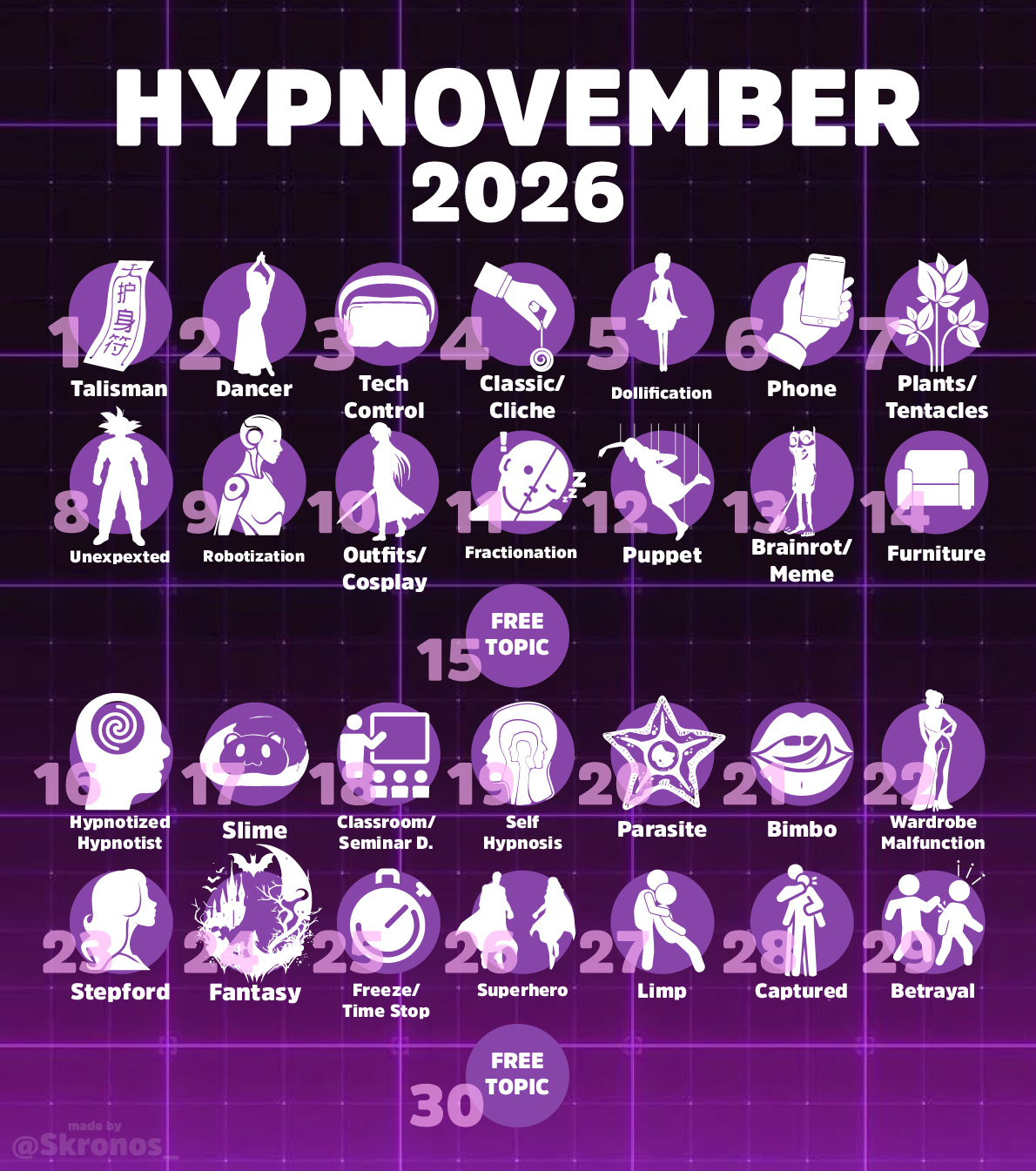
Day 17 – Culture (Slime)
The slime mold had no brain, and it had been solving problems for four hundred million years.
Dr. Rosalind Achebe explained this to every new postdoc on their first day. *Physarum* could find the shortest path through a maze. Put oat flakes on a map of Tokyo and the mold would reproduce the rail network in thirty hours. No neurons, no memory, nothing anyone would call a thought. Only a single enormous cell, flowing toward what it wanted.
The culture in the sealed tank at the back of her lab was not *Physarum*. It had come from a core sample taken ninety meters below a Finnish bog, and it glowed a soft, shifting green in the dark, like pond water with a light under it. Rosalind had spent six years learning what it did.
What it did was listen.
The compound it secreted crossed skin in under a minute. In rats, it suppressed the fear response and raised oxytocin sharply. In the one accidental human exposure, a graduate student named Priscilla, who had torn a glove in year three, it produced forty minutes of deep calm and a powerful desire to be agreeable. Priscilla had spent that afternoon cheerfully reorganizing the entire cold room because Rosalind mentioned, in passing, that it was a mess.
Rosalind had not published. There was a paper in it that would end her career in one direction and start another, and she had not yet decided which.
Then Hollis Biotech was acquired, and Dalton Reeve arrived.
Reeve was forty-four and ran a fund that bought research companies, stripped the patents, and sold the buildings. He toured the labs on a Monday in a suit that cost more than a centrifuge, flanked by two lawyers, and by Wednesday Rosalind had a letter informing her that her project was being terminated and all materials, including biological samples, transferred to a facility in Delaware.
She requested a meeting. He gave her ten minutes on Thursday at six, after everyone had gone home.
“I’ve read your file,” Reeve said, strolling into her lab without being invited. “Fourteen years, one patent, no product. The slime stays. You don’t.”
“I’d like to show you what it does,” Rosalind said. “Ten minutes. That’s all you gave me.”
He checked his watch and shrugged.
She led him to the back of the lab and turned off the overheads. In the dark, the tank glowed, and the mold inside moved in slow veins and branches, spreading toward the warm side of the glass.
Reeve, despite himself, leaned in. “What’s it doing?”
“Deciding. It doesn’t think, so it can’t be wrong. It just flows toward what feeds it and away from what doesn’t. No ego in the way.” She handed him a pair of gloves. “Put these on if you want to touch the sample tray.”
He took them. The left glove had a slit in the thumb, two centimeters long, made with a scalpel an hour earlier.
Rosalind watched him lift the lid of the tray and press his thumb against the gel. She watched his face while she counted silently to sixty.
“It’s warm,” he said. His voice had already changed, loosening at the edges.
“Yes. Keep your hand there. How do you feel?”
“Fine.” A pause. “Good, actually. Really good.” He laughed, surprised at himself. “Huh.”
“Dalton, look at me.” He did, with the open, trusting face of a man who had just set down something heavy. “You want me to be happy with you, don’t you?”
“Yes,” he said immediately.
“Good. Then we’re going to talk about the Delaware transfer.”
He rescinded it that night from her desk computer, cheerfully, while she dictated. Then he wrote a memo restoring funding to her lab for five years, doubled, and another transferring the patent rights to Rosalind personally, which his own lawyers had told him was a terrible idea when she proposed it two days later.
By then it hardly mattered what the lawyers thought. Reeve had begun coming to the lab on Fridays. He said the air in the building helped him think.
Rosalind published in the spring, though not the paper she had once imagined. She published the compound’s structure, its mechanism, and a full account of its effects on human subjects, including a signed and witnessed statement from Dalton Reeve describing his own exposure and everything he had done afterward. It made the front page of two journals and one newspaper. An ethics board met for six weeks and concluded, in careful language, that the work should continue under supervision, with Rosalind in charge of it.
She runs the Achebe Lab now, on the eleventh floor, with twenty researchers and a waiting list. The green tank sits at the back, glowing.
Reeve sold his fund. He sits on the lab’s oversight board, where he votes however Rosalind recommends and is widely considered the most reasonable man in biotech. Once a month, he visits the tank, stands in the dark with his hands in his pockets, and watches the mold flow slowly toward the warm side of the glass.
“No ego in the way,” he says, every time, as if he has just thought of it.
