

Hypnovember 2026 – Day 11
We’re entering this challenge for the first time, using the list below as a reference to write a series of flash fiction pieces. Come along on this journey, and let’s continue to have fun.
You can thank https://x.com/Skronos_ for creating such a detailed selection of deliciously kinky concepts to work with.
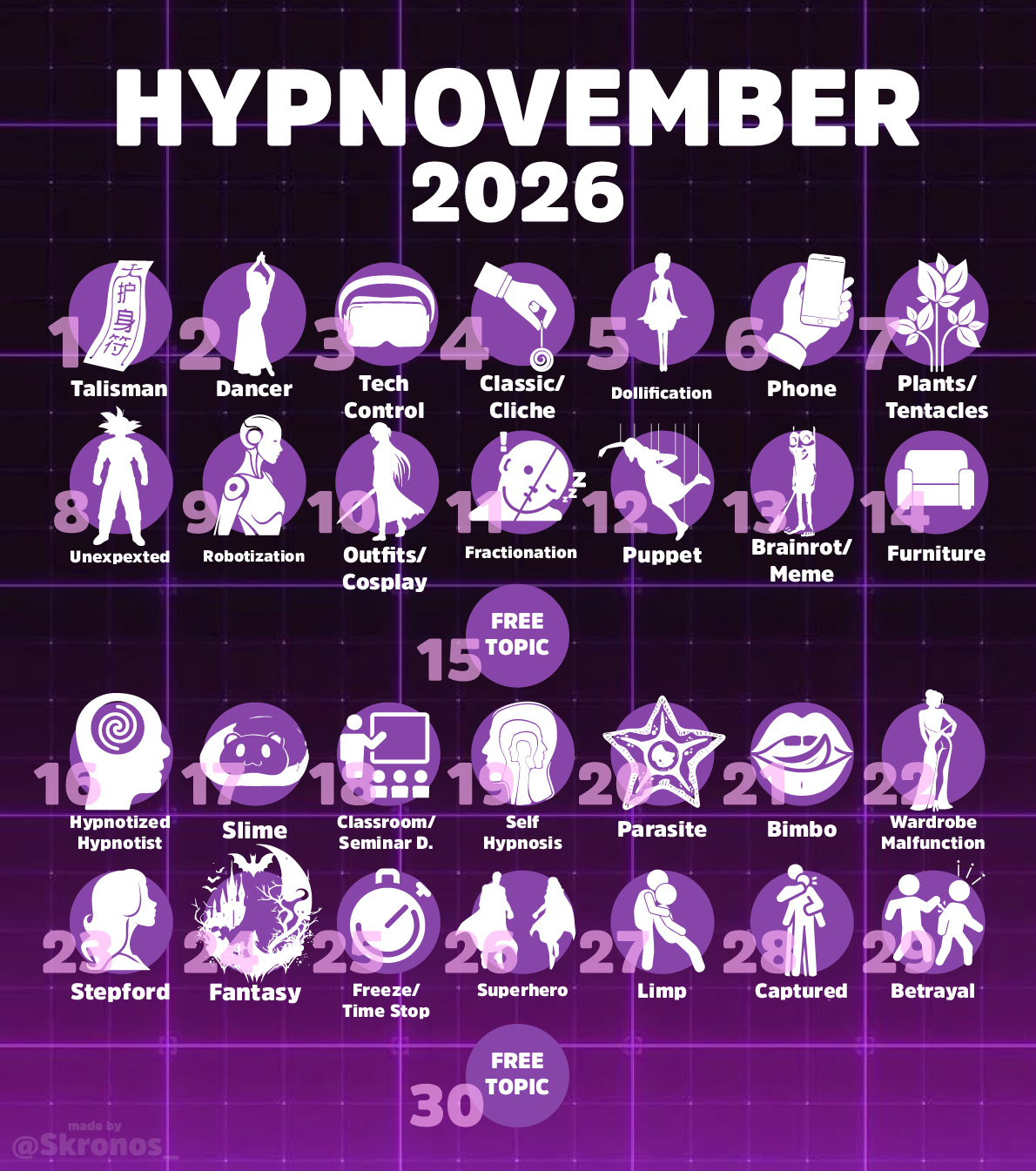
Day 11 – Snooze (Fractionation)
Gordon Pratt hadn’t touched an alarm clock since the nineties. Each morning he rose at 4:45 sharp, driven by discipline alone, and was at his emails by five. He demanded no less from his three hundred and eleven employees at Pratt Logistics.
Celeste Moreau had been his lead mobile developer for four years. In that time, she had received his emails at 4:52 on a Sunday and at 11:40 on Christmas Eve. She had watched two colleagues go on medical leave and a third leave the country. And she had built, on her own time, an alarm app called Doucement.
The name meant gently. The app did not ring. It began with a low hum like a distant train, and then came a woman’s voice, Celeste’s own, speaking in a warm Québécois accent. It woke you a little at a time. And if you hit snooze, it did something no other alarm did: it took you back down.
She had learned the technique from a sleep researcher at McGill, during a study she had joined years ago for the forty-dollar stipend. Wake a subject briefly, then let them sink again, and each descent goes deeper than the last. Researchers called it fractionation. Celeste called it the snooze button.
She gave Gordon the app in November, at the end of a meeting about delivery delays.
“You’ll hate it,” she said. “It’s for people who need help waking up.”
He downloaded it that afternoon to prove he didn’t.
The first morning, he woke at 4:45 as always, and the app spoke softly from his nightstand. “Good morning, Gordon. You’re awake. You can feel the pillow under your head and the warmth of the blankets.” It was so pleasant that he lay there listening, and when it asked, “Would you like nine more minutes?” his thumb found the button before he decided anything.
The hum returned. The voice counted down, slow and steady, and he sank into a sleep so deep and comfortable he woke nine minutes later feeling dazed.
“Good,” said Celeste’s voice. “You came up so easily. Now let’s go down again, deeper than before. Snooze.”
He pressed it.
By the third snooze, he was not entirely asleep or awake but somewhere softer than either, where her voice was the only thing that mattered. That was when she began to make suggestions. Only small ones at first. Email can wait until eight. A rested team is a fast team. He came up, she praised him, and he went down again, and each time the suggestions settled a little further in, like water sinking into dry soil.
He was late to work for the first time in twenty-six years. He arrived at 8:40, looking ten years younger, and sent no emails before nine.
Within a week, the overnight messages stopped. Within two, Gordon announced at a staff meeting that nobody was expected to answer messages after six or on weekends, and that anyone who did would be gently told to stop. The room stared at him. Celeste studied her coffee.
The app updated itself every Sunday night. Celeste wrote each new script herself at her kitchen table in Mile End, with a cup of chamomile tea and the results of an anonymous staff survey that Gordon had never read. She worked through the complaints in order. Parental leave came first, then the broken heater in the Laval warehouse, which had been broken for three winters.
Gordon fixed them all. He told the board each change was his own idea, and he believed it. He also started saying “merci” to the warehouse staff, which nobody had asked for, but which Celeste found she did not mind.
In February, she wrote the biggest script yet. It took her three evenings. She tested every line twice, then installed it on a Sunday night and went to bed early.
On Monday morning, Gordon hit snooze five times. On the fifth descent, the deepest one, her voice told him about the measurable drop in errors among rested drivers, and about the kind of man he was becoming: one who led by example. Four days, the voice said, as he floated somewhere far below the surface. Four days are enough. You’ve always known that.
He came up slowly and lay staring at the ceiling.
At ten o’clock, he called an all-hands meeting. He proposed a four-day work week, starting with a six-month trial, at full pay. He said he’d been thinking about it for a long time. He added, a little shyly, that he had been sleeping better lately, and that it had changed how he saw things.
The board approved the trial in March. By September, on-time deliveries were up nine percent, and resignations were down by half. The trial became permanent. A business magazine profiled Gordon as a reformed workaholic, and he gave all the credit to his sleep.
Celeste was promoted to head of product. She still writes the Sunday scripts. Most weeks they are gentle maintenance, like a nudge about the holiday bonus. Occasionally she adds something new.
Gordon still wakes at 4:45, but he no longer gets up. He lies in the dark, listening for her voice, and when she asks whether he would like nine more minutes, he always says yes.
